

There is a moment most people remember from their first dry needling session. The needle goes in — thin, precise, barely felt — and then something unexpected happens. A deep twitch, a spreading warmth, a sensation that sits somewhere between pressure and release. And then, minutes later, the muscle that had been locked for months quietly let go of the pain.
Dry needling is one of the fastest-growing treatments in Sydney’s health and wellness space. Liverpool and south-west Sydney residents searching for ‘dry needling near me‘ are booking appointments for everything from stubborn back pain and sciatica to posture-related neck stiffness and sports recovery. But most people who walk through the door do not fully understand what the treatment is actually doing inside their body — or why it works when nothing else has happened.
At Flame Tree Chiropractic, we have brought you everything about dry needling so that by the end of the blog, you will understand the basics.
This way, you will know the next step that is required of you now.
Without any delay, let’s get into reading-
| “Dry needling does not mask the pain. It goes to where the pain is stored — and asks the muscle to finally release it.” |
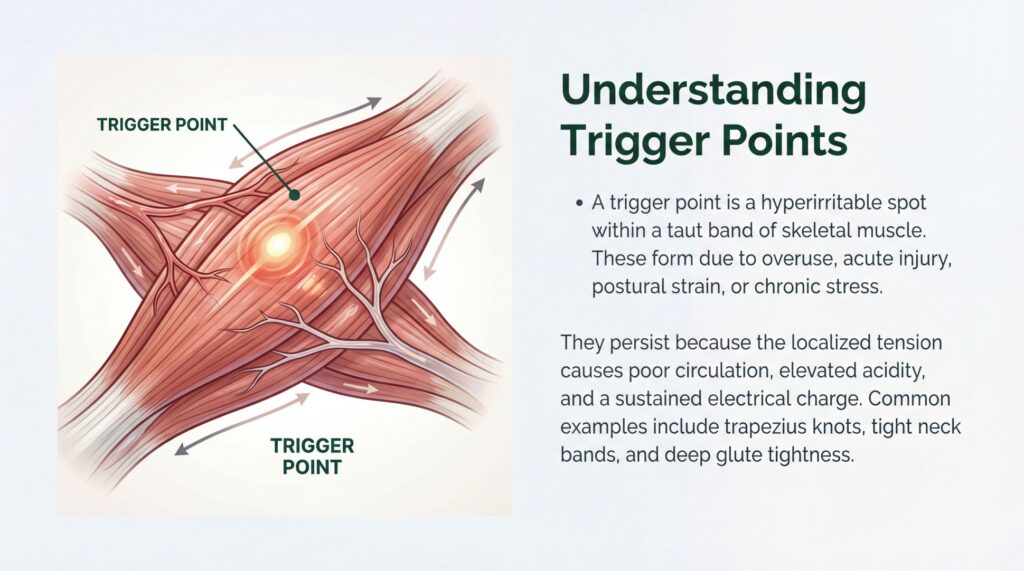
Before dry needling makes sense, you need to understand what it is targeting. A trigger point is a hyperirritable spot within a taut band of skeletal muscle — a small, dense knot of muscle fibres that have contracted and failed to release. Trigger points form in response to overuse, injury, postural strain, and stress. They are the physical storage units for tension that the body could not process and release in real time.
You have felt them. That ropey knot in your upper trapezius that hurts when you press it. The tight band along the side of your neck that refers pain to your head. The deep glute tightness mimics sciatica and sends a dull ache down the back of your leg. These are not vague areas of soreness — they are specific, identifiable structures that a trained chiropractor or dry needling practitioner can locate with precision, which you can get at Flame Tree Chiropractic.
The problem with trigger points is that the body’s usual recovery mechanisms — sleep, stretching, movement — cannot reach them. The muscle fibres in a trigger point have poor circulation, elevated acidity, and a sustained electrical charge that keeps them in a contracted state. They do not release without direct intervention. And left long enough, they create movement restrictions, postural compensations, and referred pain patterns that spread far beyond the actual source.
What Actually Happens During a Dry Needling Session
At Flame Tree Chiropractic in Casula — serving Liverpool, Prestons, Glenfield, Wattle Grove, and Moorebank — every dry needling session begins with a thorough muscle assessment. The practitioner maps the trigger points relevant to your presenting complaint, then works systematically through them in a sequence designed to produce the best cumulative result.
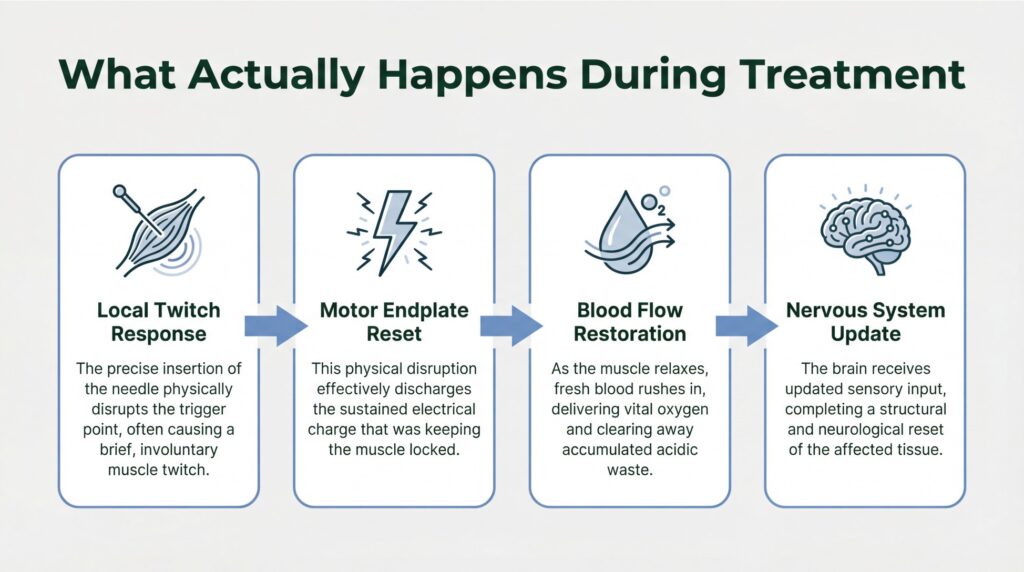
The needle — ultra-fine, solid, nothing like a hypodermic — is inserted directly into the trigger point. What happens next is physiologically specific. Let’s look into that-
- The needle stimulates a local twitch response — an involuntary contraction of the taut muscle band. This is the ‘hit’ sensation patients describe. It is the trigger point being mechanically disrupted.
- The twitch response causes a rapid reset of the motor endplate — the chemical communication point between nerve and muscle. The sustained electrical charge that was keeping the muscle contracted is discharged.
- Blood flow rushes into the previously ischaemic tissue, delivering oxygen and clearing the acidic waste products that were sustaining the trigger point’s existence.
- The nervous system receives updated sensory input from the treated area — retraining the brain’s map of that muscle and its relationship to surrounding structures.
The result is not just pain relief. It is a structural and neurological reset of a muscle that had been operating in a state of sustained dysfunction. Most Liverpool patients feel the difference during the session — a heaviness followed by lightness, a soreness that is recognisably productive rather than alarming.
Dry Needling for Sciatica and Disc-Related Pain
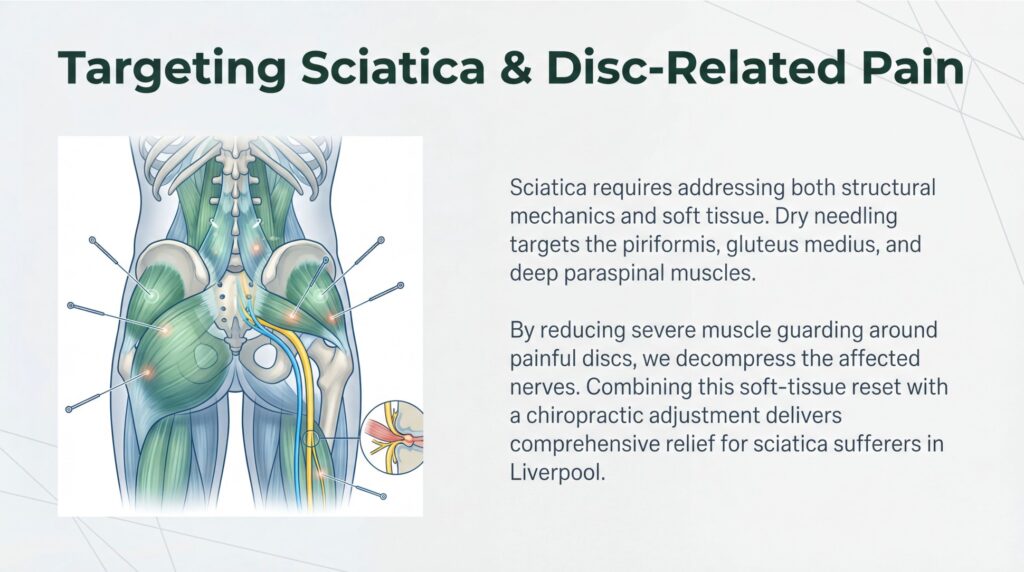
One of the most common reasons Liverpool patients search for ‘dry needling Sydney‘ is sciatica — and this is one of the areas where the treatment is most effective. When sciatic symptoms are caused or perpetuated by muscle tightness — particularly the piriformis, gluteus medius, or deep paraspinal muscles — dry needling directly at those trigger points can produce rapid and lasting relief.
This is why dry needling is most powerful when delivered alongside chiropractic adjustment at the same clinic. The adjustment corrects the spinal mechanics and reduces disc or joint pressure on the nerve root. The dry needling releases the muscular trigger points that are either compressing the nerve peripherally or perpetuating the pain pattern centrally. Neither treatment alone addresses the complete picture. Together, they cover both the structural and the soft tissue dimensions of the same problem.
For patients with disc degeneration and associated back and leg pain, dry needling also reduces the reactive muscle guarding — the spasm that develops around a painful disc as the body tries to protect the injured tissue. Releasing this guarding does not just reduce pain; it restores the movement that slows disc degeneration and maintains spinal health.
WHAT DRY NEEDLING TREATS AT FLAME TREE CHIROPRACTIC
| Lower back pain and sciatica | Neck and upper trapezius tension |
| Disc-related referred pain | Posture-driven postural strain |
| Sports injuries — calf, hamstring, shoulder | Post-training recovery |
| Headaches related to cervical trigger points | Hip and glute tightness |
| Jaw tension (TMJ) | Chronic postural fatigue |

The Posture and Rehabilitation Dimension
Dry needling is not a stand-alone cure. It is a reset — a way of clearing the muscular landscape so that rehabilitation can actually work. This is a distinction that matters enormously for patients living in Liverpool with chronic postural issues.
When you have been in a postural compensation pattern for months or years, your muscles have adapted to that position. The deep stabilisers have switched off. The superficial movers are overworking. The trigger points that have formed are both a symptom of the pattern and a structural barrier to changing it — because the muscles cannot lengthen and retrain while they are locked in a contracted state.
Dry needling clears that barrier. Once the trigger points are released, the muscle can be stretched, loaded, and retrained. The rehabilitation exercises that seemed impossible before — that never quite reached the right muscle — suddenly work. This is the sequence that produces lasting outcomes: dry needling to clear, chiropractic adjustment to restore joint mechanics, and targeted rehabilitation to entrench the new pattern.
Is Dry Needling Right for You?
Dry needling is suitable for most healthy adults experiencing muscle-related pain, stiffness, or movement restriction. It is particularly well-suited for patients who have tried stretching, massage, or rest without lasting relief — because those modalities cannot reach the trigger point directly.
Some patients who should discuss suitability with the practitioner before treatment include those who are pregnant (certain areas are avoided), those with needle phobia (alternatives are available), those on blood-thinning medication, or those with active skin infections in the treatment area. The initial assessment at Flame Tree Chiropractic covers these factors before any treatment begins.
For the overwhelming majority of Liverpool and south-west Sydney patients, dry needling is safe, well-tolerated, and produces measurable improvements within one to three sessions. Many patients feel significant relief after their first session — particularly when it is delivered in combination with a chiropractic adjustment targeting the same area.
Recent Comments